From the brink of extinction to the Asiatic lion conservation comeback, discover the story of the world’s last wild Asiatic lions and the landscape that gave them a second chance.
There are places in the world that are special because of what they protect. And then there are places that are irreplaceable because, without them, an entire chapter of natural history could disappear.
Gir, in the western Indian state of Gujarat, is one such place.
Here, among dry deciduous forests, teak woodlands, rocky hills, scrubland, and open grasslands, lives the last remaining wild population of Asiatic lions on Earth. Nowhere else in the world can you encounter these magnificent predators living freely in their natural habitat.
The story of Gir is not only about big cat conservation. It is a story of survival against the challenges, the importance of habitat protection, the active role of local communities, and what sustained conservation efforts can achieve.
A lion that once ruled a much larger world
The Asiatic lion was once distributed in a vast geographical range from parts of the Middle East and Persia to the Indian subcontinent. Its historical distribution extended from the eastern Mediterranean region towards northwestern India.
For centuries, these lions were part of the natural and cultural landscape of several regions. They were featured in royal hunting traditions, ancient art, mythology, and historical accounts. In India, the lion was a symbol of courage, strength, and royalty.
But the same admiration that made lions symbols of power also made them prized trophies. Unregulated hunting, habitat destruction, and the decline of natural prey populations gradually reduced their numbers.
By the beginning of the twentieth century, the Asiatic lion was at the brink of extinction. They disappeared from their former range, and only a few of them survived in the Gir forests of the Kathiawar Peninsula in Gujarat.
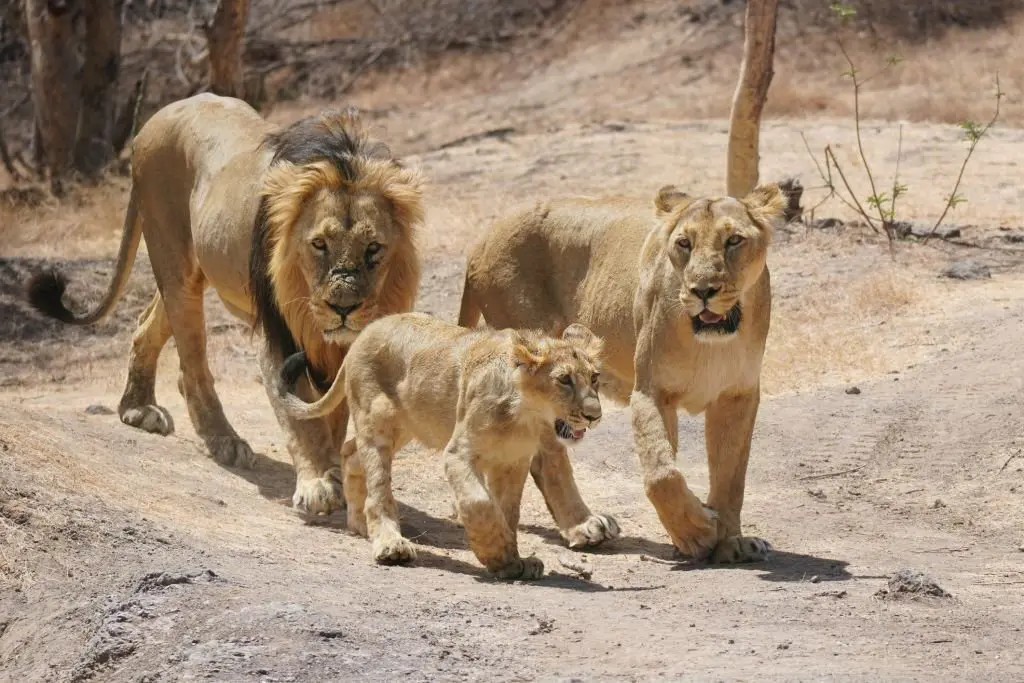
Then the Nawab of Junagadh intervened and recognized the danger facing these magnificent animals and banned their hunting. Later, after India’s independence, conservation efforts were strengthened by the establishment of protected areas and modern wildlife management.
Gir Wildlife Sanctuary was established in 1965, followed by the declaration of Gir National Park in 1975.
From a few survivors to 891 lions: Asiatic Lion Conservation
The comeback of the lions from the brink of extinction is one of the most remarkable wildlife conservation success stories of India.
Decades of protection, habitat management, recovery of prey base, veterinary care, and the involvement of local communities have helped the lion population to recover fast.
The latest population estimation, conducted by the Gujarat Forest Department in May 2025, recorded around 891 Asiatic lions, while it was 674 in 2020. This shows an increase of 32% in five years.
Their numbers not only increased, but they also started occupying a vast geographical area around Gir Forest, which is now known as the Greater Gir landscape. Their range, which was approximately 6,600 square kilometers in 1990, is now grown to around 35,000 square kilometers by 2025.
Today, lions are found in many districts of Gujarat, covering protected forests, grasslands, agricultural lands, river corridors, and coastal habitats. The 2025 estimation documented nine satellite populations beyond the major source population.
This is a great sign, which demonstrates that conservation has helped them to reclaim parts of their historical landscape.
However, it also brings new responsibilities. Protecting the Asiatic lion today means the protection of land beyond the boundaries of Gir National Park and ensuring that the wider landscape remains safe for its expanding population.
What makes the Asiatic lion different?
At first glance the Asiatic lion looks like its African cousin. Both share the main features of the lion: a powerful body, a tawny coat, formidable strength, and a commanding presence in their landscape.
When you look a little closer, you will find some distinctive characteristics.
The unique belly fold: The most recognizable physical feature of the Asiatic lion is the longitudinal fold of skin running along its belly.
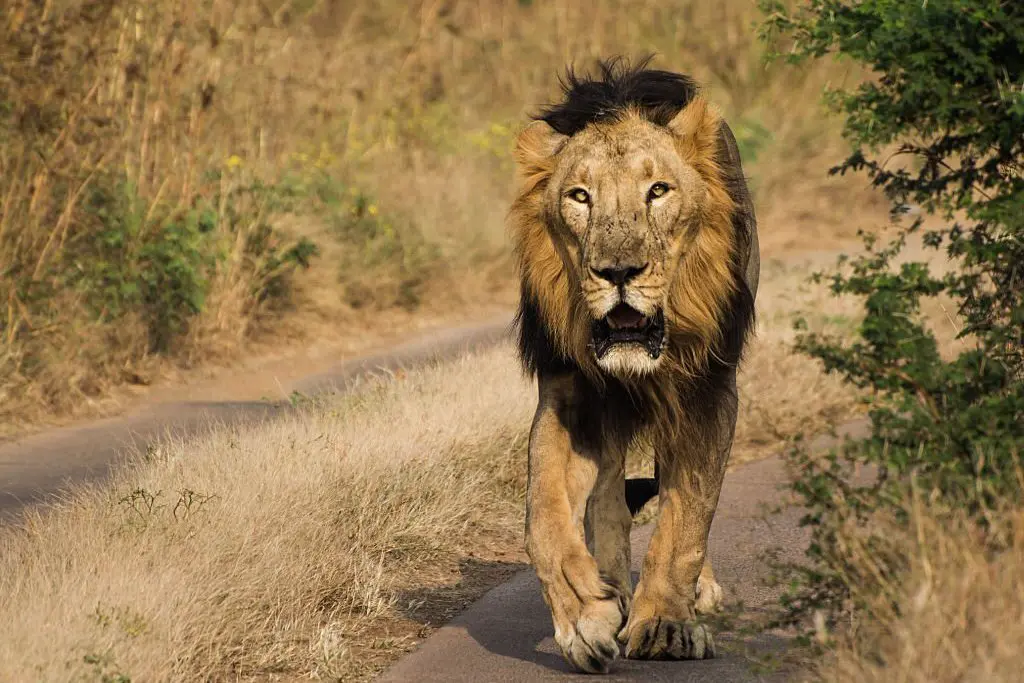
A comparatively smaller mane: Male Asiatic lions generally have a smaller and less dense mane than African lions. Because of this, their ears are more visible, and their head and neck profile looks different.
A distinctive body structure: Asiatic lions are generally smaller in build than African lions, though size varies between individuals.
Different social organization: One very interesting aspect of Asiatic lion behavior is their social structure. African lions mostly form large prides with males living alongside groups of related females; Asiatic males and females maintain separate social groups. Females form groups with other females and their cubs, while males form coalitions.
Gir: Much more than a forest of lions
When you imagine Gir, the first image that comes to mind is a magnificent male lion walking through the forest road. But Gir is much more than a protected area for an iconic species.
The landscape of Gir is a mosaic of dry deciduous forests, teak forests, scrub forests, rocky hills, grasslands, and riverine vegetation. Seasonal streams and water bodies add to its ecological diversity, creating habitats for a wide variety of wildlife.
The forest supports an impressive range of mammals, including leopards, striped hyenas, golden jackals, jungle cats, Indian grey mongooses, chital, sambar, nilgai, and four-horned antelope.
Its birdlife is equally interesting. Peafowl, crested serpent eagle, paradise flycatcher, painted stork, Indian pitta, and many other species make Gir an interesting destination for birdwatchers.
The presence of a healthy prey base is essential for the survival of the lions. Chital, sambar, nilgai, wild boar, and other herbivores form an important part of their natural diet.
For a naturalist, Gir offers an opportunity to understand an entire ecosystem rather than simply search for a particular animal. Every alarm call, pugmark, movement in the undergrowth, and change in the behavior of prey species can offer clues about the presence of a predator.
This is what makes a wildlife experience in Gir so rewarding: the forest has a story to tell even when a lion is nowhere in sight.
The people of Gir: An extraordinary story of coexistence
The most interesting aspect of lion conservation is the co-existence of lions and the local communities living around their habitat.
The Maldharis are the traditional pastoral communities living in the Gir landscape. Their settlements, livestock, and traditional way of life are dependent on the forest.
Unlike other regions where the presence of large carnivores creates conflict, Gir has developed a unique relationship between people and lions. There are challenges in this relationship, like livestock predation, occasional human-wildlife encounters, and competition for space.
Yet local acceptance, cultural associations with the lion, compensation mechanisms, and conservation initiatives have played an important role in its survival.
The protection of Asiatic lions is not only within the boundary of protected areas and government action alone. It also reflects the contribution of people who share this landscape with wildlife.
As the lion population is expanding into agricultural areas, villages, and other human-dominated landscapes, community participation becomes even more important. Conservation must ensure that the benefits of protecting wildlife are shared with the people who live alongside it.
The hidden danger: One population, one major vulnerability
The growing population of Asiatic lions is without any doubt a conservation success. But behind this encouraging story lies a serious concern.
For generations, the survival of the entire wild Asiatic lion population depended on one principal geographical region: Gir and its surrounding landscape.
This concentration makes the species particularly vulnerable to a large-scale disease outbreak, natural disaster, or other catastrophic event.
The danger is not merely theoretical. In 2018, an outbreak of canine distemper virus affected lions in the Gir landscape, resulting in the deaths of at least 23 animals. This incident highlighted how a single deadly disease could wipe out the whole population concentrated within a particular location.
Another major concern is the growing interface between lions and people. As their distribution expands, lions increasingly move through agricultural fields, villages, roads, and other human-dominated areas. This creates risks from road and railway accidents, open wells, retaliatory actions, and other human-related pressures.
The increasing population, therefore, brings a new conservation challenge: how to provide enough safe habitat for the lions while maintaining a healthy relationship with surrounding communities.

Why a second home matters
For years, conservationists have emphasized the importance of establishing another free-ranging population of Asiatic lions outside the Gir landscape.
The idea is simple but fundamental: a species should not have its entire wild future dependent on a single geographical location.
The proposed translocation of lions to Kuno National Park in Madhya Pradesh has been the subject of extensive scientific and legal discussion. Although the relocation did not materialize, the need for a geographically separate population remains an important conservation consideration.
Meanwhile, Barda Wildlife Sanctuary in Gujarat has emerged as an important additional habitat. Lions have naturally dispersed into this landscape, and the 2025 estimation recorded 17 individuals there.
This is a positive development, but geographical separation matters. A nearby satellite population is not necessarily an adequate safeguard against a catastrophe affecting the wider region.
Long-term conservation must therefore focus on suitable additional habitats, secure corridors, disease preparedness, and scientifically informed population management.
Experiencing Gir: An encounter with India’s only wild lions
For wildlife enthusiasts, a visit to Gir National Park is an opportunity to experience not only India’s most extraordinary natural heritage site but also a conservation success story.
During the safari the visitors visit different habitats of Gir Forest, where finding the lions is an exercise in understanding the forest itself.
A lion sighting can happen unexpectedly. It might be a male resting beneath a tree, a lioness moving with her cubs and other members of pride through the undergrowth. Mostly the indication of lion presence comes from the alarm calls of langurs and deer.
And sometimes forests remain quiet, which reminds us that animal sighting is not guaranteed.
Beyond lions, visitors can enjoy the rich birdlife, diverse mammals, and beautiful landscapes of Gir. The experience is especially rewarding when accompanied by a knowledgeable naturalist who can explain animal behavior, tracks, calls, and other signs of the forest.
Gir is not simply about photographing a lion. It is about understanding why this landscape is so important and what it takes to protect its extraordinary biodiversity.
Why the future of the Asiatic lion matters
The story of the conservation of the Asiatic lion carries a message.
A century ago, the world came dangerously close to losing this magnificent animal. Today, its growing population demonstrates what long-term protection, political commitment, scientific management, and community participation can achieve.
Yet 891 lions do not mean that the species is out of danger. Its continued survival depends on maintaining healthy habitats, protecting wildlife corridors, reducing human-wildlife conflict, strengthening veterinary preparedness, and establishing additional secure populations.
The next chapter of the Asiatic lion’s story must be about making its future more secure, not simply increasing its numbers.
Gir has given the Asiatic lion a second chance. The responsibility now lies with us to ensure that this umbrella species continues to roam the Indian wilderness for generations to come.

At Nature Safari India, we believe that wildlife travel should go beyond sightings and photographs. It should create a deeper appreciation of nature and strengthen commitment to conservation.
A journey to Gir is an opportunity to witness one of the world’s most remarkable wildlife recovery stories and experience the only place on Earth where wild Asiatic lions continue to survive.
And perhaps, as you watch a lion disappear into the dry deciduous forest, you will realize that you are witnessing something far more significant than a wildlife sighting. You are witnessing a conservation legacy that the world cannot afford to lose.
If you like our Asiatic Lion Conservation story, also give a read to Comeback of tiger in Arunachal’s D’Ering Memorial Wildlife Sanctuary after 10 years




0 Comments