Rehabilitation: The topic of wild animal rehabilitation raises numerous questions. Why do we rehabilitate wild animals? Which species needs rehabilitation, and when should it be done? It’s difficult to answer precisely, but for us, rehabilitation is necessary for species that are fewer in number or highly endangered. Rehabilitation is mostly when they are fit enough to survive in the jungle. Most of the animals for rehabilitation are kept in zoological parks or rescue centers.
There is a dedicated department in most zoological parks known for conservation breeding, where animals are kept away from human imprints and in a natural environment. The purpose of keeping them is to release them into the forest as needed. All endangered species in India are covered in the conservation breeding program, and zoos, mostly located close to their natural habitat, are the coordinating zoos with three to four participating zoos. Zoos exchange animals with each other to avoid inbreeding and to maintain pure, genetically strong individuals.

Ghorella Enclosure
In Kanha Tiger Reserve, in the year 2006-07, an enclosure was created to rehabilitate the tigers in the wild. It was not an ordinary enclosure; the whole plan is to create a place where an orphaned tiger cub gets his schooling under the observation of the forest department, but without any human imprinting.
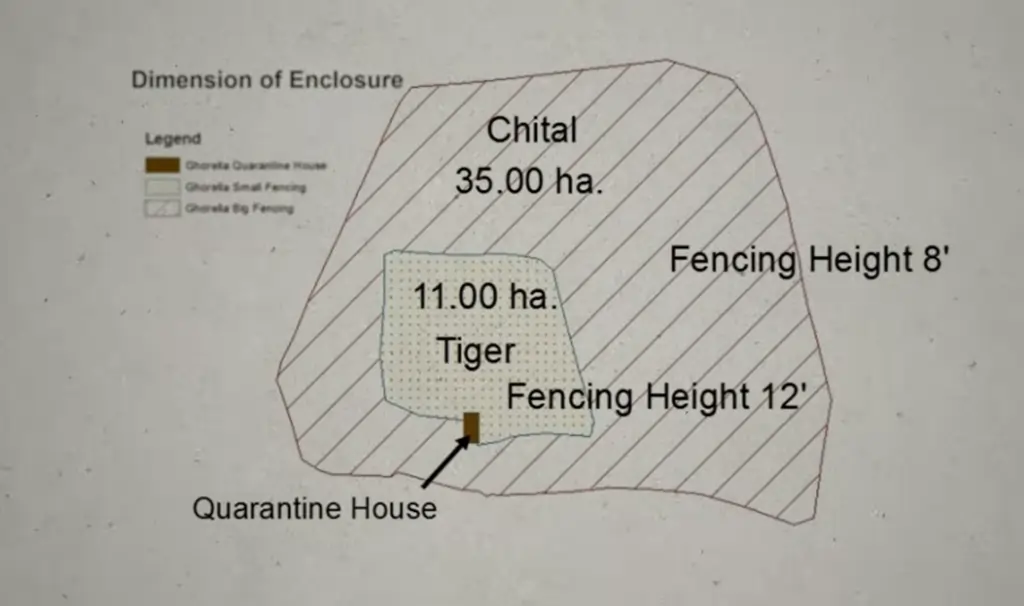
The enclosure is divided into three parts: the bigger part, which is 35 hectares and has an 8-foot-high fence; a small enclosure within the big one, which is 8 hectares in area and has tiger-leopard-proof fencing around it; and the third part, which is attached to the small enclosure, which is a quarantine center where the rescued tigers are kept initially.
The enclosure is primarily designed for orphaned tiger cubs, and the idea originated when a tigress died in Kanha, and her three cubs were rescued by the forest department. The rescued cubs were trained in the enclosure and then rehabilitated in the tiger reserves. One of the female cubs of the first batch was shifted to Panna Tiger Reserve, where all the tigers were locally extinct; now, Panna has more than 70 tigers.
The Process of Rehabilitation
When a cub is rescued, it is initially kept in the quarantine center after initial medical checkups. Depending upon the age, they are fed milk or meat, live hen, and then live goat. When they are 14-15 months old, they are released into the big enclosure, where they start hunting deer. Once they have completed hunting 100-15 deer and reached the age of more than two years, they are released into the wild with a radio collar to monitor their movement.

Once they establish their territory, their radio collar is removed, and they live the life of a true wild tiger. During the whole process, the human imprint is almost nil except at the time of rescue and when they were very young cubs. Basically, the Ghorella enclosure is a kind of training center for tigers where the teaching is how to behave like a tiger in the wild.
A few years back, a tiger was rescued from human habitation and was sent to the Ghorella enclosure because of his habit of entering into the villages, but it was difficult because he was a fully grown tiger, and changing his habit was not possible, so even after spending time in the enclosure, he was sent to a rescue center where he has to spend the rest of his life.
Pattewala Tiger: The King of Mukki in Kanha
The story of Pattewala tiger is one of the most inspiring stories of a rescued and rehabilitated tiger in India. His life started in a challenging and scary situation, but then he was rescued, and now he is one of the most dominant tigers of the Mukki zone in the Kanha Tiger Reserve.
Pattewala tiger was an orphaned tiger cub whose mother was presumed to have died during the flood in Kanha about six years ago. He was stranded in a flood, floating on a log. He was a weak and scared six-month-old tiger cub. Someone saw him floating and informed the forest department. They came for rescue, but it was not an easy task; the floodwater was gushing, and the rapid was so strong.
With lots of effort, they rescued him. He was kept in the Ghorella rehabilitation enclosure, first in a quarantine cage and later in a carnivore-proof enclosure. When he became 14-15 months old, he was shifted to the larger enclosure, where he started hunting the deer successfully. After attaining the age of two years and having a successful hunting experience, it was fitted with a radio collar and released into the wild. This is how he got his name: “Pattewala,” which means a tiger with a radio collar.
A tiger in the wild does not have an easy task, because you are the strongest in the jungle; nature always gives you challenges. These challenges come from the other territorial tigers, humans, co-predators, and even from prey. Every second in the life of a tiger is a challenge.

Like other tigers, Pattewala tiger also started searching for a suitable territory with the availability of two to three females. To survive in the wild, you have to be smart, and Pattewala is a really smart tiger. Most of the time, he avoided any conflict with resident tigers and tried to find a vacant space where he could settle, but being a male tiger in a tiger-rich area, you have to fight at least one male tiger, and it happened with him also.
This fight was with a Balaghat male tiger, who was an older tiger compared to the Pattewala tiger. Though the real fight nobody had seen, a dead body of a Balagaht male tiger with fight marks was found in the jungle, and the presence of the Pattewala tiger nearby is an indication of a fight between the two giants.
He established his territory in the Mukki zone and found mates with three females and also fathered a few cubs. Now Pattewala tiger is a dominant male of the Mukki zone in the Kanha Tiger Reserve, a major attraction for tourists and a strong gene provider for the future tigers of the landscape.
Pattewala tiger’s success in the wild shows that tigers and other wild animals can survive in the wild even if orphaned and the role of the Ghorella enclosure in the conservation and rehabilitation of wild tigers.
Also read – Top 5 Best Tiger Safari Tour Operators in India & Top 10 Most Legendary Tigers of India