Family Viverridae: The Civets of India
In my previous blogs, I’ve delved into the fascinating world of wildlife, covering a wide spectrum of animals. Some are quite common, easy to spot, and familiar to many of us. Others are rarer, with populations that are slowly dwindling, while a few are critically endangered, existing in such small numbers that encountering one is a rare and thrilling experience. The less abundant an animal is, the more elusive it becomes, adding an extra layer of excitement to the search for these remarkable creatures.
Today, I want to introduce you to an animal that, despite being relatively common, often goes unnoticed. It’s a species that thrives not only in dense forests but also in the countryside and even in the outskirts of villages. Yet, surprisingly, many of us have never had the chance to see one in the wild. This curious fact is highlighted by two intriguing instances I’ll share later in this blog.
The focus of today’s discussion is the civet, a fascinating and somewhat mysterious member of the family Viverridae. Civets of india are known for their secretive nature and nocturnal habits, which contribute to their rarity in sightings despite their widespread presence. These small, cat-like creatures are often overshadowed by more prominent wildlife, but they play a crucial role in their ecosystems, making them a subject well worth exploring.
Family Viverridae
Civets belong to the family Viverridae, which also includes genets and linsangs. This diverse family comprises 35 species distributed across 20 genera, found primarily in southern Europe, Africa, and Asia, including regions like Indonesia and the Philippines. Viverrids are omnivorous, with diets that range from insects and small mammals to fruit, making them adaptable to various environments.
One of the fascinating aspects of Viverridae is their elusive nature. These small, secretive creatures typically inhabit forests and dense vegetation, making them some of the most poorly known carnivores. Many viverrid species are found only in isolated locations, such as islands or small, restricted areas, which further adds to their mystery.
Physically, most viverrids have slender bodies, complemented by long tails and short legs ending in four- or five-toed feet. Their elongated necks and heads taper into a pointed muzzle, with small ears and, in most species, anal scent glands. The family exhibits a range of behaviors, with some species being nocturnal and others diurnal.
India is home to eight species of civets, some of which are widely distributed across the country, while others are confined to more specific, limited areas. In this article, we will explore each of these species in detail, shedding light on their unique characteristics and habitats.
Binturong (Arctictis binturong)
IUCN Status: Vulnerable
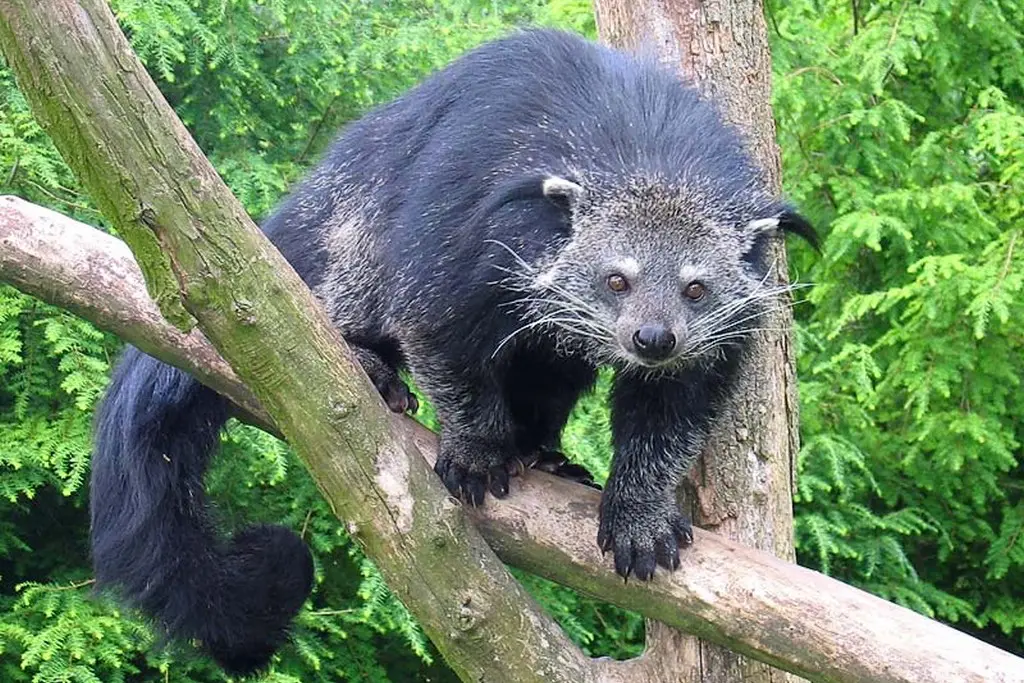
The Binturong, the largest of the civets found in India, is easily recognized by its distinctive black coat, grizzled with long whiskers and white-edged ears. One of its most unique features is its muscular, prehensile tail, which is nearly as long as its head and body, allowing it to grasp and maneuver through trees with ease. Interestingly, female Binturongs are larger than their male counterparts, adding to the uniqueness of this remarkable species.
Distribution: The Binturong has a wide distribution across Southeast Asia, extending from the Eastern Himalayas through Nepal, Sikkim, and Bhutan, and reaching across Assam, Tripura, Nagaland, and Arunachal Pradesh in India. Its range continues eastward through Myanmar, Thailand, Malaysia, and Indonesia, and even reaches the Philippines.
Behaviour: The Binturong is a largely arboreal and nocturnal animal, preferring the cover of mature forests where it spends most of its time. It is generally solitary, though it may be observed in small groups, particularly with immature offspring. As an omnivore, the Binturong has a varied diet that includes fruits, shoots, insects, birds, and small mammals, with occasional reports of it catching fish.
The gestation period for the Binturong is about 92 days, typically resulting in a litter of one to two young, which are weaned after eight weeks. In captivity, Binturongs have been known to live for over 18 years, showcasing their resilience and adaptability.
Small-toothed Palm Civet (Arctogalidia trivirgata)
IUCN Status: Least Concern
The Small-toothed Civet, a rare species native to the northeast, is a distinctive buff-brown forest civet characterized by its grey head, dark feet, and long tail. It is easily identifiable by the three dark lines running along its back from neck to rump and a white line stretching from its forehead to the tip of its nose. Although it shares a similar external appearance with the common palm civet, these unique markings help distinguish it within its habitat. The civets of India include this unique species, setting it apart from other civets found in the region.
Distribution: The Small-toothed Palm Civet is distributed across a broad range in Southeast Asia. In India, it is found primarily in the northeastern regions, possibly extending from West Bengal, Assam, Nagaland, Manipur, Mizoram, and Arunachal Pradesh. Its range continues through Myanmar, southern China, Thailand, Malaysia, Indonesia, and Singapore. As one of the notable civets of India, it contributes to the region’s rich biodiversity.
Behaviour: The Small-toothed Palm Civet is primarily solitary, although it can sometimes be observed in small groups, particularly females with their young. It is an arboreal and nocturnal species, typically found in evergreen and semi-evergreen forests. During the day, it often rests on the upper branches of tall trees. As an omnivore, its diet consists of insects, small mammals, birds, and predominantly fruits. The species has a gestation period of 45 days, usually resulting in a litter of three. In captivity, the Small-toothed Palm Civet reaches maturity at around 17 months and has an average lifespan of 10 years. This distinctive member of the civets of India adds to the fascinating wildlife of the region.
Common Palm Civet (Paradoxurus hermaphroditus)
IUCN Status: Least Concern
The Common Palm Civet, the most widespread civet of India, can be easily distinguished from the Small Indian Civet by its un-patterned throat and tail. Its body color varies greatly, ranging from a rich cream to brownish-black or even jet black, with dark spots that often merge into stripes along its sides and at the base of its tail. Three longitudinal stripes run along its back up to the tail, which are visible upon close inspection. These distinct markings help differentiate it from the Himalayan Palm Civet and the Brown Palm Civet, which share parts of its range. The tail is as long as its head and body, and the facial markings are variable, often featuring a white patch or spot below and above the eyes, as well as on each side of the nose.
Distribution: The Common Palm Civet has an extensive distribution across Asia. In India, it ranges from northern Pakistan through the entire country, from Gujarat to Jammu and Kashmir, and throughout the southern peninsula, extending down to Sri Lanka. Its northern range includes Nepal, Bhutan, and southern China, extending eastward through West Bengal, Assam, and Arunachal Pradesh, and further into Myanmar, Thailand, Malaysia, Indonesia, the Philippines, New Guinea, and even Japan. This widespread distribution highlights its adaptability to a variety of habitats across the region.
Behaviour: The Small-toothed Palm Civet, like other civets, is primarily solitary, nocturnal, and largely arboreal, though it readily descends to the ground to cross open spaces. It favors well-wooded forests and often roams through plantations, finding shelter in the hollows of trees. Interestingly, it also adapts to living near human habitation, often residing on roofs or in homesteads. As an omnivore, its diet includes birds, rodents, insects, and various fruits such as Tendu, banana, pineapple, coffee, and berries. It has a ‘sweet tooth’ and is very fond of the fruits of palm and honey. The young are typically born in lairs within tree hollows or among boulders, with a usual litter size of three to four. They reach maturity at around 11 to 12 months of age.
Common but rare: The Common Palm Civet is one of the most commonly found wild animals living in close proximity to human habitation, thriving as a commensal species. Despite their abundance, they are rarely seen, largely due to their nocturnal habits. Most sightings reported through camera traps, roadkill incidents, or indirect signs. Their elusive nature is highlighted by two particular incidents I encountered.
During a safari in Kanha Tiger Reserve, I came across a dead Common Palm Civet and when asked I was surprised to learn that many park guides couldn’t identify the animal. On another occasion, a civet was killed by a speeding vehicle within the campus of Banaras Hindu University in Varanasi. I photographed the specimen and showed it to several friends who were studying there, and none of them could recognize it. This is the kind of elusive nature this animal possess.
Because people see them very rarely, they often mistaken it for other animals, such as the honey badger, which has the reputation of digging up of graves and eating corpses. The Common Palm Civets of india ability to remain largely unseen, even while living so close to humans, adds to its mysterious reputation.
Brown Palm Civet (Paradoxurus jerdoni)
IUCN Status: Least Concern
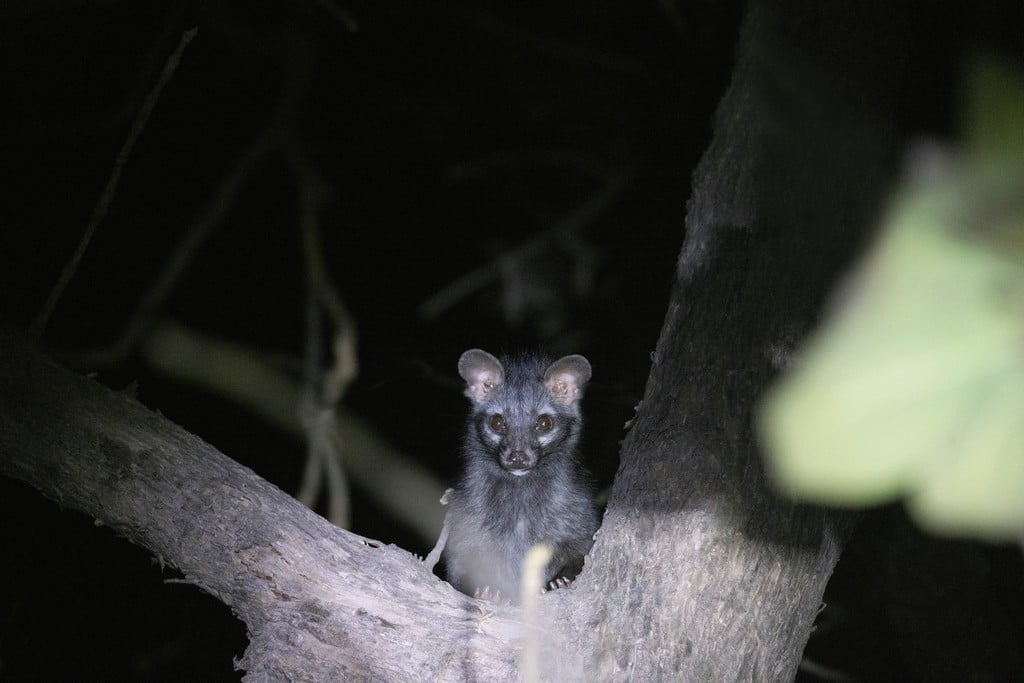
The Brown Palm Civet closely resembles the Common Palm Civet in size and appearance but lacks the distinct markings on the face and body. It has a darker head, tail, and limbs, with a more buff-colored shoulder and greyer flanks. Its tail, which is nearly as long as its body and head combined, features a lighter brown to dirty white coloration at the distal end, setting it apart from its more commonly seen relative.
Distribution: The Brown Palm Civet is endemic to the Western Ghats, where it is primarily distributed across the Palni, Nilgiri, Anamalai hills, Travancore, and Coorg regions. This species is typically found at elevations ranging between 500 to 1,300 meters, favoring the dense forests and hilly terrains of these areas.
Behaviour: The Brown Palm Civet is primarily found in well-wooded forests, often in the vicinity of coffee estates. It is largely arboreal and nocturnal, spending much of its time in the trees. This species is predominantly frugivorous, with studies showing that it feeds on the fruits of nearly 40 different rainforest trees and liana species. Occasionally, it supplements its diet with birds, rodents, and insects, but its diet is mainly composed of fruit, making it an important seed disperser in its habitat.
Also Read : Silent Predator
Himalayan or Masked Palm Civet (Paguma larvata)
IUCN Status: Least Concern
The Masked Palm Civet stands out among Indian civets due to its distinctive white whiskers and the absence of spots or stripes on its body. It is larger and heavier than the Common Palm Civet, with a relatively longer, cylindrical tail that is thickly muscular at the base and two-thirds the length of its head and body. The body color ranges from uniform greyish black at the extremities to almost pure black, with greyish-buff underparts. The tail is often tipped white. The face features a regular pattern of black and greyish white, typically including a semicircular band of creamy white hair behind and below the eyes, though this pattern can vary among individuals.
Distribution: The Masked Palm Civet has the widest distribution range among all civet species. In India, it is found throughout the Himalayas, from northern Pakistan and Jammu & Kashmir to Arunachal Pradesh, passing through Punjab, Himachal Pradesh, Uttar Pradesh, West Bengal, Sikkim, and Assam, and extending southward to the Andaman Islands. Beyond India, its range includes Nepal, Bhutan, and southern China, stretching eastward into Myanmar, Thailand, Malaysia, Indonesia, Taiwan, and Japan, showcasing its remarkable adaptability across diverse habitats.
Behaviour: The Masked Palm Civet shares many behavioral traits with the Common Palm Civet. It is primarily arboreal, nocturnal, and largely solitary, preferring to inhabit mountain and hill forests where it takes shelter in tree hollows. Its diet mainly consists of fruits, but it also supplements this with rodents, birds, insects, and roots. When threatened or agitated, the Masked Palm Civet can eject a foul-smelling secretion from its four anal glands as a defense mechanism.
Breeding occurs in tree holes, with a litter size ranging from 1 to 4. Juvenile Masked Palm Civets often have less distinct facial markings and exhibit dorsal markings similar to the Common Palm Civet, which can sometimes lead to confusion in identification in the field.

Large Indian Civet (Viverra zibetha)
IUCN Status: Least Concern
The Large Indian Civet is a robust and distinctively marked species, characterized by its large size, pointed muzzle, and long, compressed body, which sits atop short, stumpy legs—a build typical of true civets. A notable feature of this species, shared with other members of the genus *Viverra*, is the presence of well-developed skin sheaths on the third and fourth digits of the forefeet, designed to protect the claws. Additionally, the feet are thickly covered with hair between the pads, providing extra protection and traction.
The civet’s general coloration is a mix of grey or tawny tones with a yellowish or brownish hue. Its flanks are adorned with indistinct dark spots or mottling, which can be black or dark brown. The face is marked by a whitish patch on each side of the muzzle, contrasting with the blackish chin and fore throat. A broad forehead separates the anterior edges of the ears.
One of the most striking features of the Large Indian Civet is the erectile black spinal stripe or crest, which runs from behind the shoulders to the base of the tail. This stripe is complemented by pronounced dark bands on the chest and shoulders, which form loops and rosettes on the hindquarters. The tail, almost half the size of the head and body combined, is marked by five to eight dark bands separated by pale rings that extend up to its tip, adding to the civet’s distinctive appearance.
Distribution: The Large Indian Civet is distributed across Northern India, with its range possibly extending from Chamba in the west to North Bengal and Sikkim in the east. Its presence continues eastwards, covering regions such as Orissa, Assam, Meghalaya, Nagaland, Manipur, and Arunachal Pradesh. Beyond India, this species has also been reported in Nepal, Myanmar, Thailand, Singapore, and mainland Malaysia, indicating a broad geographical range across South and Southeast Asia.
Behaviour: The Large Indian Civet is a nocturnal and primarily solitary animal, spending most of its time on the forest floor, although it is also an adept climber. It has a largely carnivorous diet, preying on various animals and supplementing its meals with fruits. In India, it has even been observed fishing, and in China, crabs have been found in its gut contents, showcasing its opportunistic feeding habits. The breeding season occurs in May and June, during which the civet typically produces a litter of 3-4 young ones. In captivity, the maximum recorded lifespan of the Large Indian Civet is 15 years and five months.

Malabar Civet (Viverra civettina)
IUCN Status: Critically Endangered
The Malabar Civet is the most endangered civet species and possibly the most endangered mammal of India. Last reported in Kerala in 1990, this civet is nearly comparable in size to the Large Indian Civet. Its coat is long and fully grey, giving it a distinctive appearance. The body pattern is blackish and more pronounced compared to that of smaller civets. One of the Malabar Civet’s most striking features is its prominent black dorsal crest, which runs from the neck to the tip of its tail. The tail is further distinguished by five white rings, with the last ring positioned about two inches from the tip.
Distribution: The Malabar Civet is endemic to the Western Ghats in southern India. It has primarily been recorded in the coastal districts of this region, ranging from Kanyakumari in the extreme south to Honnavar in Karnataka in the north, extending as far as Wayanad and Coorg. Reports of its occurrence in the higher elevations of the Western Ghats are rare, with only two known instances.
Behaviour: The Malabar Civet was once widespread in the lowland forests within its range, but its current habitat has become highly restricted. In northern Kerala, it now appears to be confined to thickets in cashew plantations and severely degraded lowland forests. This nocturnal species retreats to scrub forests and cashew plantations during the day for shelter. Its typical habitat includes lowland swamp and riparian forests in the coastal plain districts of the Western Ghats. However, little is known about its ecology and biology, underscoring the need for further research and conservation efforts.
Also Read : The Tiger and Their Close Cousins
Small Indian Civet (Viverricula indica)
IUCN Status: Least Concern
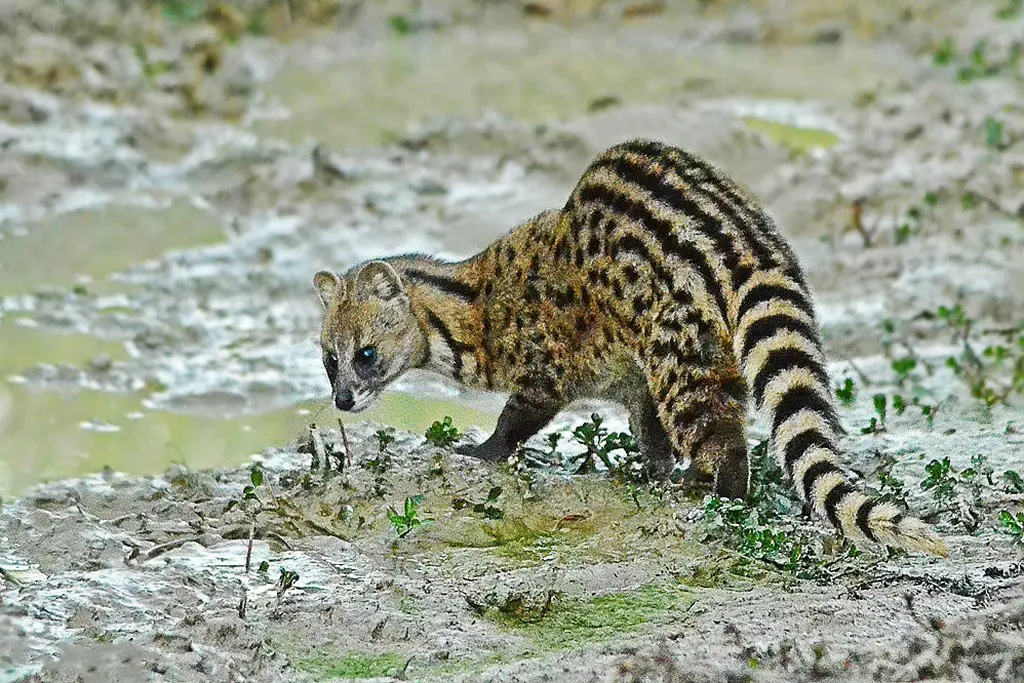
The Small Indian Civet has a somewhat cat-like appearance, featuring relatively long forelegs and prominent rounded ears. Its general body color ranges from sandy-buff to greyish white, adorned with blackish spots arranged in parallel horizontal lines. The spots on the spine are smaller and tend to merge into a continuous line, while those on the flanks are larger and more spaced apart. All four legs are dark brown or blackish, often marked with small white patches.
The tail, which is about two-thirds the length of the head and body, is distinctly marked with 9-10 concentric black rings. The throat and breast are greyish white, highlighted by two thick black semicircular bands on the upper throat. Unlike some other civets, the Small Indian Civet lacks a dorsal crest, and the anterior edges of its ears are set close together, adding to its distinctive profile.
Distribution: The Small Indian Civet is one of the most widely distributed civet species in India, second only to the Common Palm Civet. Its range extends beyond India, reaching into Pakistan, eastern regions including southern China, Myanmar, and Thailand, as well as southward to Sri Lanka, Singapore, Malaysia, and Indonesia. This wide distribution highlights its adaptability across various habitats in South and Southeast Asia.
Behaviour: The Small Indian Civet is a solitary and strictly nocturnal animal, typically preferring to live in areas with long grasses and scrub. Although it is capable of climbing trees, it primarily hunts on the ground. Its diet is mostly omnivorous, including rodents, lizards, insects, small birds, bird eggs, nestlings, and often fruits. The civet lives in burrows it digs itself or under rocks, providing it with shelter and protection.
This species is polyestrous, meaning it can breed multiple times a year, and young civets are seen throughout the year, with litter sizes ranging from 3 to 5 offspring. In captivity, the Small Indian Civet can live for around 22 years.
Civet Coffee
The trade of civet coffee, also known as kopi luwak, involves a controversial process where civets of India are kept in captivity and force-fed coffee cherries. The cherries pass through the civet’s digestive system, during which the beans undergo fermentation, imparting a unique flavor profile to the coffee. After being excreted, the beans are collected, cleaned, and processed into coffee. This practice, prevalent globally and notably in Indonesia, has sparked significant ethical concerns, particularly regarding the suffering of the animals involved.
In India, while the trade is less prominent, there is growing awareness and concern about the impact of such practices on civets. These animals are often confined to small cages, deprived of their natural behaviors, and subjected to poor living conditions, leading to physical and psychological distress. The commercial demand for civet coffee perpetuates these inhumane practices, highlighting the urgent need for stricter regulations and the promotion of cruelty-free alternatives in the coffee industry.
Conclusion
In the above paragraphs, we have learned about the species of civets found in India and how they are integral to the forest ecosystem. At the end, we have come to the conclusion that civets, with their diverse roles from seed dispersers to predators, are vital for maintaining ecological balance. Their presence supports forest health by controlling insect and rodent populations, and by contributing to the regeneration of plant species. However, it is equally crucial to address the challenges they face, such as habitat loss and unethical practices like the civet coffee trade.
By enhancing conservation efforts, promoting ethical practices, and raising awareness, we can ensure the survival and well-being of these fascinating creatures, preserving their ecological functions for future generations.